
Material
What is MDF, actually?
MDF is one of the most used and least understood building materials in a house. This page fixes that: no sales pitch, just the material, with every number sourced.
What MDF is
MDF stands for medium-density fiberboard. It is an engineered wood panel made by breaking wood down into individual fibers, combining those fibers with a resin binder, and pressing the mixture under heat and pressure into a dense, uniform board[2][5].
The key word is fibers. Plywood is thin layers of veneer. Particle board is chips and flakes. MDF is wood reduced further, to the fiber, which is why a cut MDF edge looks smooth and consistent instead of showing chips or grain. That uniformity is the whole point of the material: it behaves the same in every direction and takes a clean machined profile[2][5]. MDF is graded to ANSI A208.2, the recognized North American standard for the material, and its physical properties are measured by the ASTM D1037 test method[2][4].
How it is made, in brief
The process is straightforward to describe, even though it is demanding to control. Wood, often mill residuals and small-diameter material, is chipped and then steamed and refined into fine fibers. The fibers are blended with a resin binder and additives; the binder chemistry is what determines a board's formaldehyde emissions, which is why emissions are a manufacturing decision, not an accident[7][8]. The blended fibers are formed into a mat and pressed under heat and pressure, which cures the resin and sets the board's density and thickness[5]. The board is then cooled, sanded to thickness, and cut to size.
Two mills can run this same process and produce very different boards. The variables that move most, fiber quality, resin, and how hard the mat is pressed, are exactly the variables that decide density and strength. That is why "MDF" alone does not tell you what you are getting. See the full manufacturing walk-through →
How grades and standards work
ANSI A208.2 does not define a single MDF. It defines a family of grades across a range of density and strength values[2]. A panel can legally be called MDF while sitting near the bottom of that range or near the top. Both are MDF. They are not the same product, and they will not perform the same in a screw-held joint or a load-bearing shelf.
Emissions are governed separately. In the United States, EPA TSCA Title VI sets federal formaldehyde limits for composite wood, and California's CARB Phase 2 sets the standard that most of the industry now builds to nationwide[7][8]. Some panels go further with no-added-formaldehyde binders. Compliance here is documented and verifiable, so it is a fair thing to ask any supplier to prove. The practical takeaway: a grade name is a floor, not a description.
Where MDF sits by density
Density is the single most useful number for placing a wood-fiber panel, because it tracks closely with strength, screw-holding, and edge quality. Here is the map, in pounds per cubic foot.
| Panel | Density (lb/ft³) | Notes |
|---|---|---|
| Particle board | generally lighter, coarser | Own standard, ANSI A208.1[1] |
| MDF | ~41 to 50 | A wide band[5][9]. Low and high ends are meaningfully different materials. |
| HDF (high-density) | above 50 | Denser, harder[5][9]. A different density class, not "better MDF." |
| Vaultwood Core™ | 45 to 49 | Upper MDF band, deliberately below the HDF line[11]. Premium MDF, not HDF. |
Note the boundary. HDF is not simply "better MDF." It is a different density class above 50 lb/ft³, and calling a premium MDF "HDF" is an error, whether it is made out of confusion or convenience[5][9].
The blend, and how dense
What "medium density" actually means
MDF is wood taken all the way down to its fiber and pressed into a dense, uniform panel with no grain and no voids. Density places it: at 45 to 49 pcf, Vaultwood Core sits in the upper MDF band, below the HDF line at 50 and above light commodity board. Here is the difference in real material, photographed.
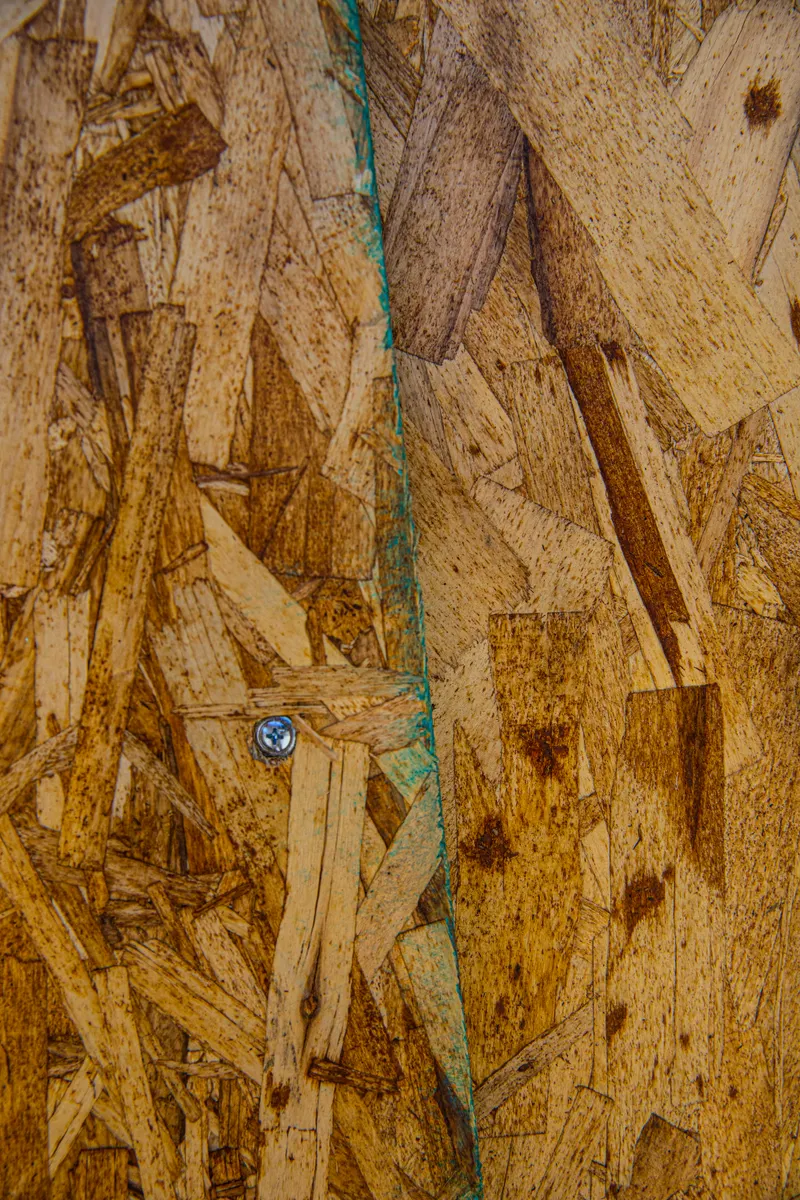

Real photographs, not diagrams. MDF is the only one of the four with no grain direction and no internal voids, which is why it stays flat, machines to a clean edge, and holds a screw the same everywhere on the panel.
Why premium MDF differs from commodity
If MDF is a range, then "premium" has to mean something specific or it means nothing. Commodity MDF is purchased to the loosest grade that still qualifies as MDF, because that is the cheapest board that passes. It may perform perfectly well. It also may vary from panel to panel, because nothing in the purchase required consistency beyond the minimum. Premium MDF is purchased to a tighter specification and held there. The way to tell the two apart is not the label, it is whether the seller will hand you numbers:
- Density, in lb/ft³, and a stated band rather than a single lucky sample.
- Modulus of rupture, in psi, with the test method named. ASTM D1037 is the standard method[4].
- Face screw-holding, in lbf, which predicts whether hardware and fasteners stay put.
- Emissions compliance, documented to TSCA Title VI and CARB Phase 2[7][8].
As a worked example, Vaultwood Core™ is specified with a modulus of rupture over 4,500 psi, up to 5,500 psi[11], tested per ASTM D1037[4], and face screw-holding of 275 to 350 lbf[11], at the density noted above[11]. Those are the kinds of figures a premium spec is willing to publish. The number that matters most is the one a seller will not give you.