
From fiber to panel
How Vaultwood Core is made
Vaultwood Core™ is engineered panel by panel from refined wood fiber, so every board that carries the standard behaves the same under a hinge, a router bit, and a coat of finish. Here is the whole sequence, in the open.
Vaultwood Core is a premium medium-density fiberboard (MDF) standard, not a species of raw lumber and not high-density fiberboard. It is produced only by specified suppliers, including Weyerhaeuser Super-Refined MDF2, Roseburg Medite, and WestPine EcoGold[11], and it is held to a written specification at every step below.

Stage 01 · Recovered fiber
It starts with wood that would otherwise be waste
MDF is made largely from wood residuals, the chips, shavings, sawdust, and small-diameter wood left over from other wood manufacturing, refined into fiber rather than cut from new boards[5]. Putting that stream back to work is one of the practical sustainability advantages of well-made MDF. We describe that benefit narrowly and by its source.
Stage 05 · Hot pressing
Heat and pressure set the density that carries the load
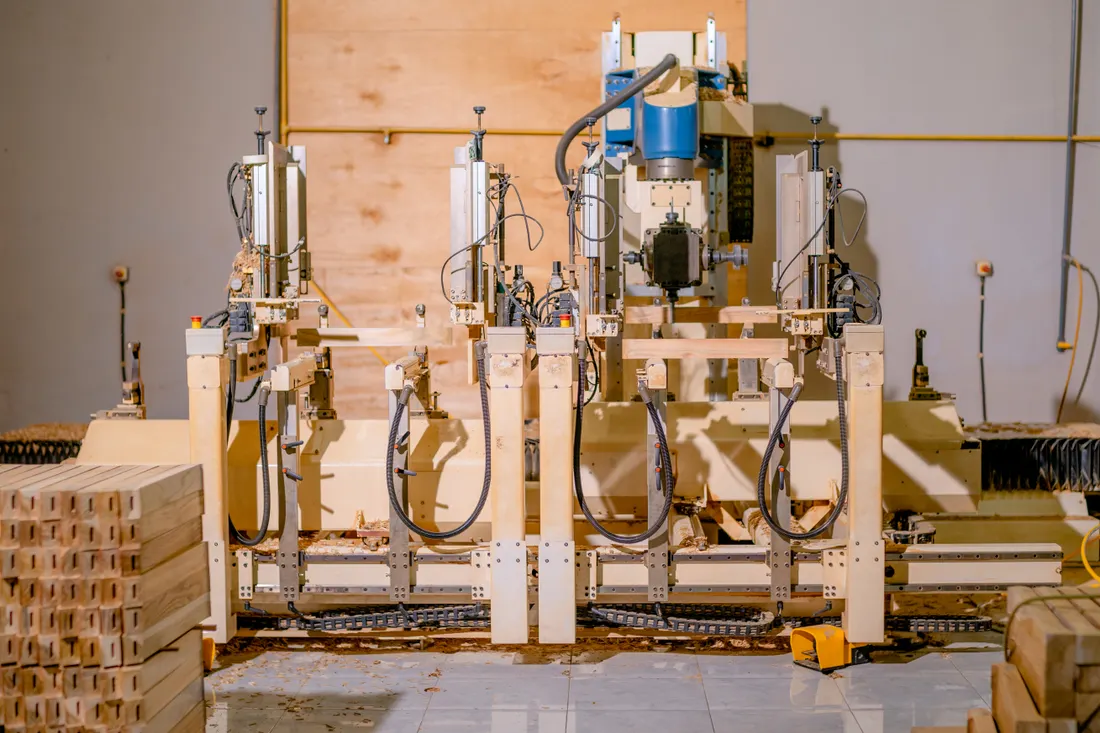
The resin-blended fiber is formed into an even mat, then compressed under heat and pressure. The heat cures the resin; the pressure sets the panel to its target density. Vaultwood Core is specified at 45 to 49 pcf with a modulus of rupture over 4,500 psi[11], a band deliberately higher than commodity board and what lets a finished door carry real structural load.

Stage 07 · Testing and conformance
A spec is only real if the panel is tested against it
Finished panels are evaluated using the standard test methods for wood-base fiber and particle panels, ASTM D1037[4], against the MDF property requirements of ANSI A208.2[2]. These are the recognized industry references for density, internal bond, and modulus of rupture. Documentation for specified suppliers is on file[11].
The full sequence
Seven stages, one specification
Recovered wood fiber
Chips, shavings, sawdust, and small-diameter wood are collected as feedstock[5].
Refining to fiber
Refined into individual fibers of consistent size, giving MDF its uniform, grain-free structure[5].
Blending with resin
Binder chemistry governs emissions; panels meet EPA TSCA Title VI and CARB Phase 2, and WestPine EcoGold is NAF[7][8][11].
Mat forming
Fiber is distributed into an even, continuous mat for consistent density with no soft spots.
Hot pressing
Heat cures the resin and pressure sets the panel to 45 to 49 pcf, MOR over 4,500 psi[11].
Curing and sanding
Panels are cooled and cured, then calibrated and sanded flat and smooth.
Testing and conformance
Evaluated per ASTM D1037 against ANSI A208.2 requirements[4][2].
The result
A dense, uniform, grain-free core you can specify and check
Two mills can run this same process and produce very different boards. The variables that move most, fiber quality, resin, and press, are exactly the ones that decide density and strength. That is why Vaultwood Core is bought to a number, not a name.